
Getting Started in Wild West Pioneers
Camera, overlays, HUD, and the first-hour loop before you found Dust Creek.
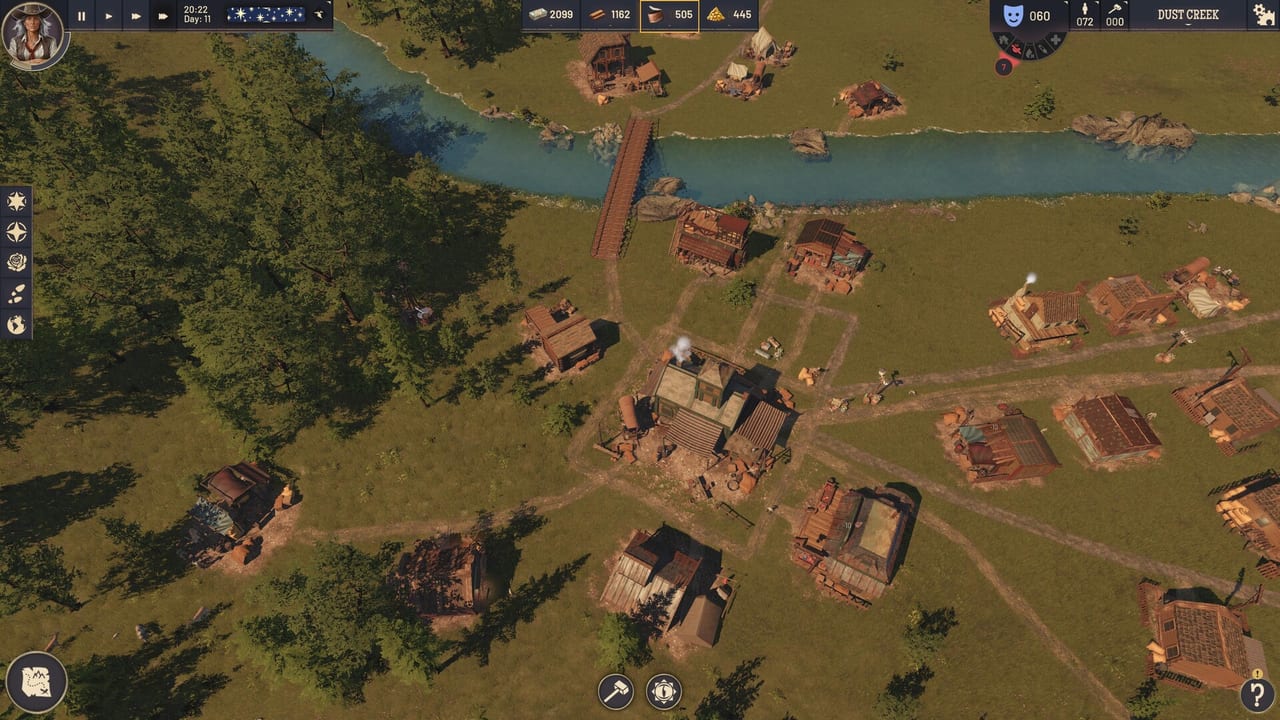
Wild West Pioneers puts you on a wagon trail in the 1800s and asks you to found a town that can feed itself. EmpireCraft Studios (Poland) builds it; Toplitz Productions (Germany) publishes it. The game is single-player on Windows PC, with Early Access scheduled for 25 September 2026 on Steam, GOG, and the Epic Games Store. Steam app 3222640 is the listing to wishlist. A public price has not been posted.
This page is the first-hour briefing. It does not replace First Settlement (site pick and Town Hall) or the demo walkthrough (one sitting from overlay to scout). It teaches the camera, the left-side overlays, the build hammer, and the resource HUD so those later pages can talk about logistics instead of buttons.
Steam listed a playable demo in February 2026 around Steam Next Fest. An open playtest window runs 2–14 September 2026 from 08:00 UTC. Confirm Windows specs on system requirements before you install either build. The demo is a teaching slice, not the year-long Early Access plan described on Early Access notes.
Camera, overlays, and the build hammer
Footage and the in-game tutorial agree on a small control set. Q and E rotate the camera. Overlay toggles sit on the left: water for tents and other buildings that must drink, wildlife for a hunter cabin that actually sees game. The build hammer lives at the bottom of the screen. Full key notes live on controls.
Placement uses three colors. Blue means the footprint is valid. Yellow means you can place it but you will lose resources (trees under a house, animals under a cabin). Red means invalid: slope, overlap, or outside the Town Hall radius. Read the color before you confirm. Buildings can be moved later from the top of a building panel, so a slightly wrong warehouse is a tax, not a restart.
Time controls sit beside the HUD. The day cycle matters because hunters, haulers, and shops resolve work across daylight. A skip-the-night option exists. Use it after you have assigned workers, not as a way to ignore a dry well. If people are already hungry, skipping darkness only delivers the morning complaint faster.
Read the HUD before you expand
The resource strip tracks logs, planks or boards, barrels (bourbon), and gold. Logs come from a logger cabin. Boards come from a sawmill. Barrels are the saloon product that travels to homes. Gold is the purse for expeditions and trade, not a reason to skip food. If boards sit at zero, stop planning a second street and finish the wood chain.
Workforce is the hidden fourth resource. A warehouse connection demands haulers. The closer a cabin sits to storage, the fewer people you burn on walking. That rule is the entire point of production chains. Do not staff a pretty ring of buildings if the inner ring is empty.
The first-hour loop, in order
- Survey water and wildlife with the overlays, then plant a Town Hall inside reach of both.
- Build a warehouse before any gatherer. Gathering without storage is a scenic walk.
- Place a logger cabin close to the warehouse and standing trees.
- Place a hunter cabin on the wildlife overlay, still inside a cheap hauler range.
- Drop tents or houses on water, then a well and a food shop.
- Add a sawmill when logs pile up, then a saloon so bourbon can move to homes.
- Unlock a scout cabin, then a settler base, then look at the world map.
That sequence is also the spine of First Settlement. The demo tech tree shows Trail Camp, then Dusty Village, then Pioneer Settlement. Journey quests grant XP toward scouts, a water tank, a worker camp, a settler base, a sawmill, a well, and a food shop. You can take the story slowly. A missing father who never returned west sits beside optional gold-rush quests; the main campaign is not a forced march.
Story, voice, and pace
Settlers talk. Current builds use real actors; the studio replaced earlier AI placeholder lines. Listen once, then play the town. Happiness is a system with needs (food, shelter, health, entertainment) and later Whims (a cat, a fence, a saloon, a church, benches, pets, instruments). Unhappy people leave. Settlers is the page for that pressure. Expeditions is the page for scouts, ghost towns, and a second Town Hall.
English has full audio. French, German, Spanish (Spain), Polish, Simplified Chinese, and Russian cover interface and subtitles. This wiki publishes English, French, German, and Spanish.
What not to chase on day one
Do not plan a railroad. It is a later goal. Do not found a second town before the first food shop stocks a ration. Do not treat gold as a win condition while tents sit off the water overlay. Do not invent extra buildings from memory; if it is not on the building list or the building priority list, wait for a tooltip.
The skip-the-night button is a teaching tool, not a skip-the-game button. Use it to watch a hauler route, a hunter return, or a saloon barrel reach a house. If the morning HUD looks worse, you skipped a problem, not a wait. For a calendar of tests rather than buttons, read the playtest window so the February Steam listing and the 2–14 September 2026 08:00 UTC test stay distinct in your head.
Frequently Asked Questions
Quick answers for settlers heading west.
What are the basic camera and build controls?
Q and E rotate the camera. Overlays sit on the left. The build hammer is at the bottom. Expedition flow is click a scout expedition, pick a location, then Explore. See controls for the full set.
What do blue, yellow, and red placement colors mean?
Blue is a valid footprint. Yellow places the building but costs resources under the footprint. Red is invalid. Water and wildlife overlays tell you whether tents and hunter cabins belong there.
Can I move a building after I place it?
Yes. Footage shows a move control at the top of the building panel. Use it to pull a warehouse closer to cabins instead of restarting the town.
Should I skip the night in the first hour?
Skip only after workers are assigned and a well or food shop is actually producing. The day cycle is how haulers and hunters finish jobs. Skipping a dry town just delivers the morning complaint sooner.
Is Wild West Pioneers single-player?
Yes. Official store pages list a single-player campaign. Plan towns, caravans, and the missing-father story as a solo map, then continue with First Settlement.